Given the evolution of the climate and the growth of pollution-generating activities in recent years, sources of air pollution need to be identified and monitored quickly, especially in crowded urban areas. Today, air quality in Romania is monitored daily through the national network of 148 stationary units that continuously measure the concentrations of the main atmospheric pollutants, with 41 local data collection centers. Independent networks measuring air pollution levels add to these, yet the total number of deployed sensors still does not sufficiently cover all relevant areas. According to reports by the World Health Organization, air pollution considerably affects human health in the European Union, causing over 450,000 premature deaths every year. City populations are exposed to this risk because of exceeded concentrations of atmospheric pollutant emissions (particulate matter, nitrogen dioxide and ground-level ozone). In addition, factors such as vibrations and noise pollution lower the quality of life in crowded cities.
Why are traditional air quality monitoring stations not enough?
How do mobile stations differ from other air quality monitoring solutions?
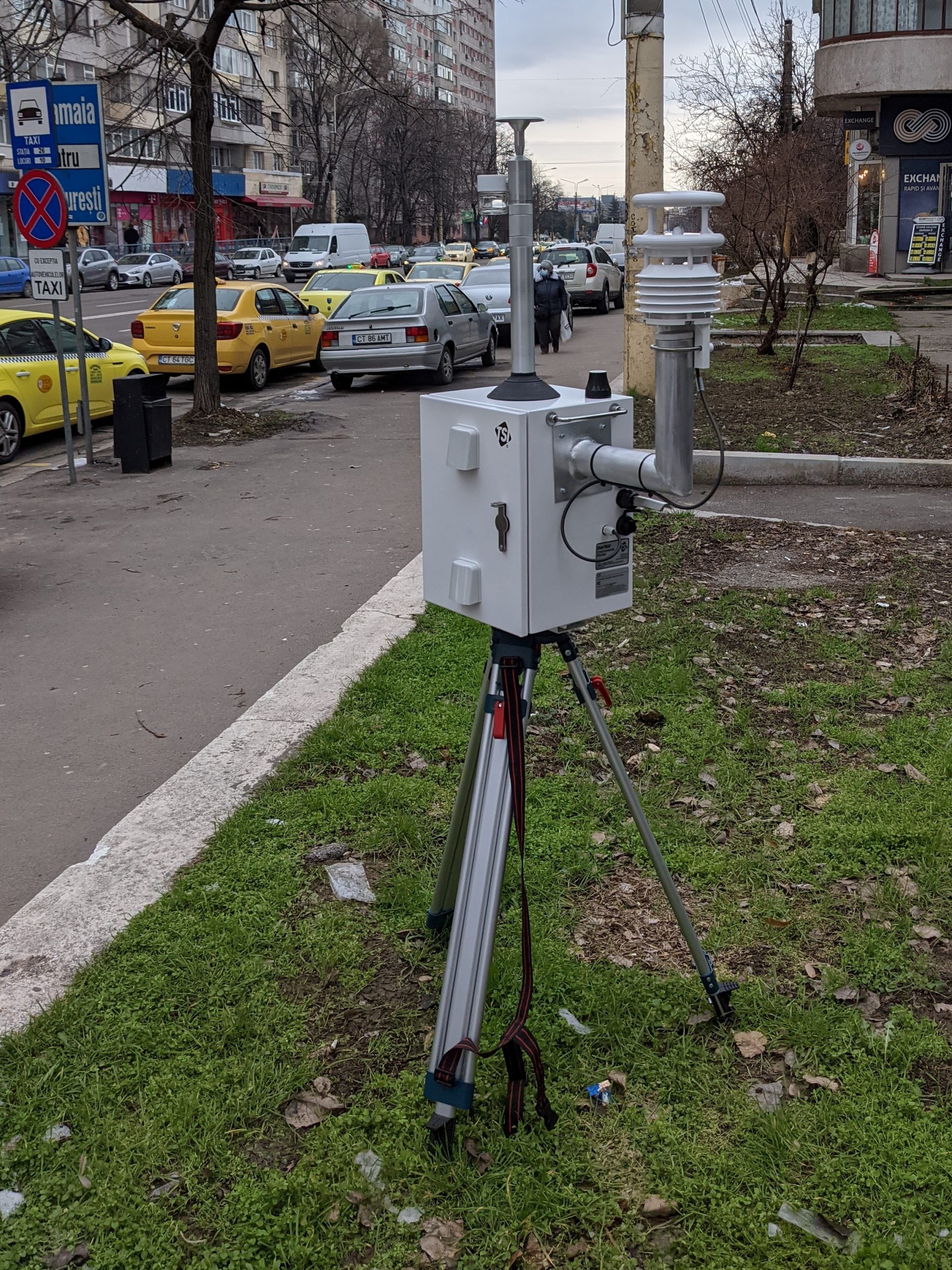
Fixed air quality monitoring stations consist of automatic equipment installed in the main cities, at key points of the urban infrastructure such as central squares, busy boulevards and city entrances or exits, in order to monitor the concentrations of the main types of pollutants. Although they provide highly accurate data, they represent significant investments for the authorities and involve relatively high operating and maintenance costs, which limits their density over a given area. Another drawback is that these stations do not provide precise information about the pollution generated on construction sites or near unmodernized industrial facilities. The data are generally published online, but they do not offer a valid overview of air quality, precisely because of the small number of monitoring points. Urban areas are the most exposed to high levels of atmospheric pollutants, due both to the higher population density of cities (which drives the intensity of road traffic) and to the faster pace at which various industries develop, all of them potential sources of contaminating emissions. It is precisely this dynamic of the urban environment that leads to the need for flexibility, to the decision to invest in a solution that can prove its effectiveness in several areas. The Claritech solution integrates further capabilities such as mobility, metrological calibration of the components and extended measurements, as well as the possibility of remote monitoring in real time.
Mobility
The monitoring system integrates compact equipment that can be transported and put into operation easily, without affecting data accuracy, and is powered by batteries that provide more than 8 hours of runtime. At startup, the system connects automatically through a secure VPN over a mobile data connection.
Metrological calibration
The equipment includes self-adjustment and air preconditioning functions that can ensure metrologically valid results.
Extended measurements
Besides monitoring PM10 particulate matter levels, the system includes a high-performance weather station (measuring temperature, atmospheric pressure, wind speed and humidity), a GPS positioning module, a vibration measurement module and integrated equipment for measuring noise pollution.
Remote monitoring
The station’s control software can be operated remotely, with data collection and online reports available in real time as charts, tables and status indicators in a dashboard application. Alert thresholds or predefined target values can be tracked. Depending on the chosen thresholds, alerts and notifications are generated, and the measurement data are saved automatically for reporting purposes.
The Claritech solution, part of the “Joint monitoring and protection of the environment in the Black Sea Basin” project
Constanța County Council is strengthening its system for monitoring the environment in the Black Sea Basin by building an efficient infrastructure with the Claritech solution - all with optimal operating and maintenance costs, and with equipment that is easy to transport and put into operation. The mobile-station air quality monitoring system is a useful control instrument for the authorities and supports prompt reactions: immediate measures can be taken by checking environmental conditions in multiple locations. By reporting correct data, the system also informs the public and helps raise awareness of the real level of air quality. More details about the components of the air quality monitoring solution are available on the environmental monitoring solution page.